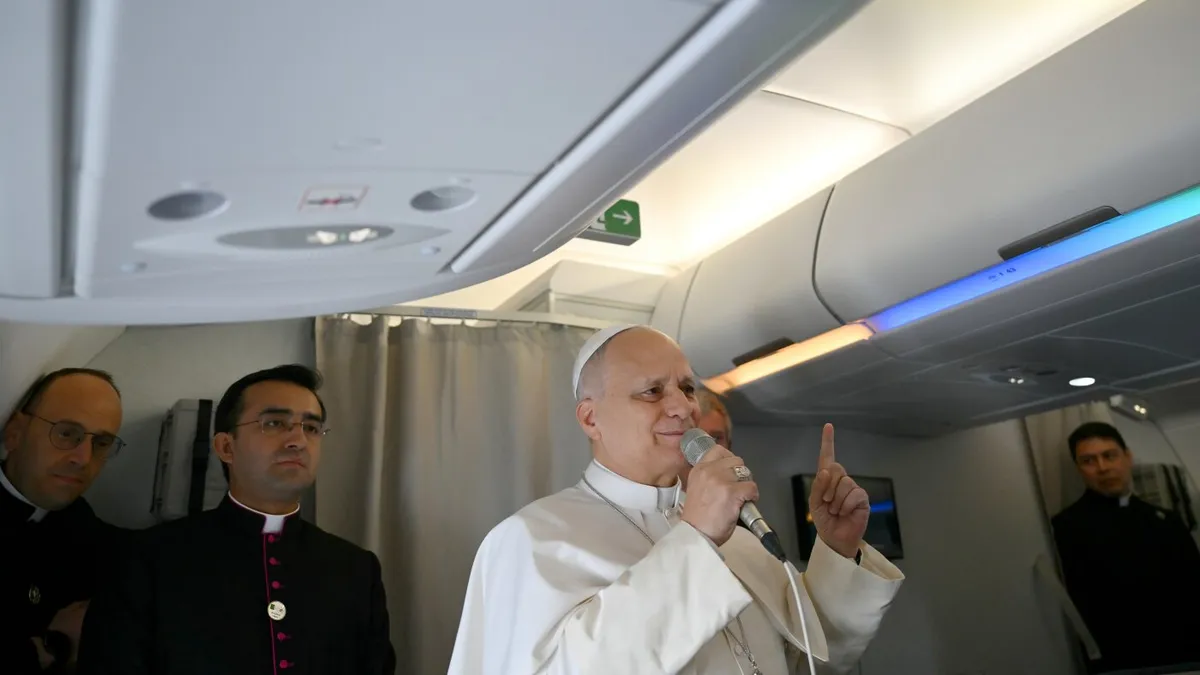
In a striking escalation of political and religious rhetoric, Donald Trump has drawn comparisons between himself and Jesus, a move that has sparked significant backlash from Pope Leo XIV. This controversy comes as the Pope embarks on an 11-day trip to Africa, emphasizing peace amidst ongoing conflicts, particularly regarding Iran.
Pope Leo XIV, the first U.S.-born pope, has openly criticized Trump’s approach to foreign policy, labeling it as weak and detrimental. During a recent statement, he asserted, “I will continue to speak out loudly against war,” highlighting his commitment to peace in the face of escalating tensions.
Trump’s provocative remarks included a post on his Truth Social account where he depicted himself as Jesus, a move that has drawn sharp criticism from various quarters. He claimed that if he were not in the White House, the Pope would not be in the Vatican, suggesting that the Vatican elected an American pope to deal with him.
The former president did not hold back in his critique of Pope Leo XIV, stating, “Pope Leo is WEAK on Crime, and terrible for Foreign Policy.” He further expressed his discontent with the Pope’s stance on Iran, saying, “I don’t want a Pope who thinks it’s OK for Iran to have a Nuclear Weapon.”
Support for Trump’s comments has emerged from some Italian politicians, reflecting a divide in perceptions of the Pope’s role and effectiveness. Meanwhile, Pope Leo XIV has called for reconciliation, stating, “Too many people are suffering today, too many innocent people have been killed, and I believe someone must stand up and say that there is a better way.” This statement underscores the Pope’s focus on humanitarian issues amidst political strife.
Trump’s influence remains significant, as evidenced by his winning 55% of Catholic voters in the 2024 election. This demographic’s response to the current tensions may shape future political landscapes.
As the situation unfolds, the implications of this rhetoric on U.S.-Vatican relations and broader geopolitical dynamics remain uncertain. Details remain unconfirmed regarding potential shifts in diplomatic stances as both figures navigate their respective roles in a polarized environment.
