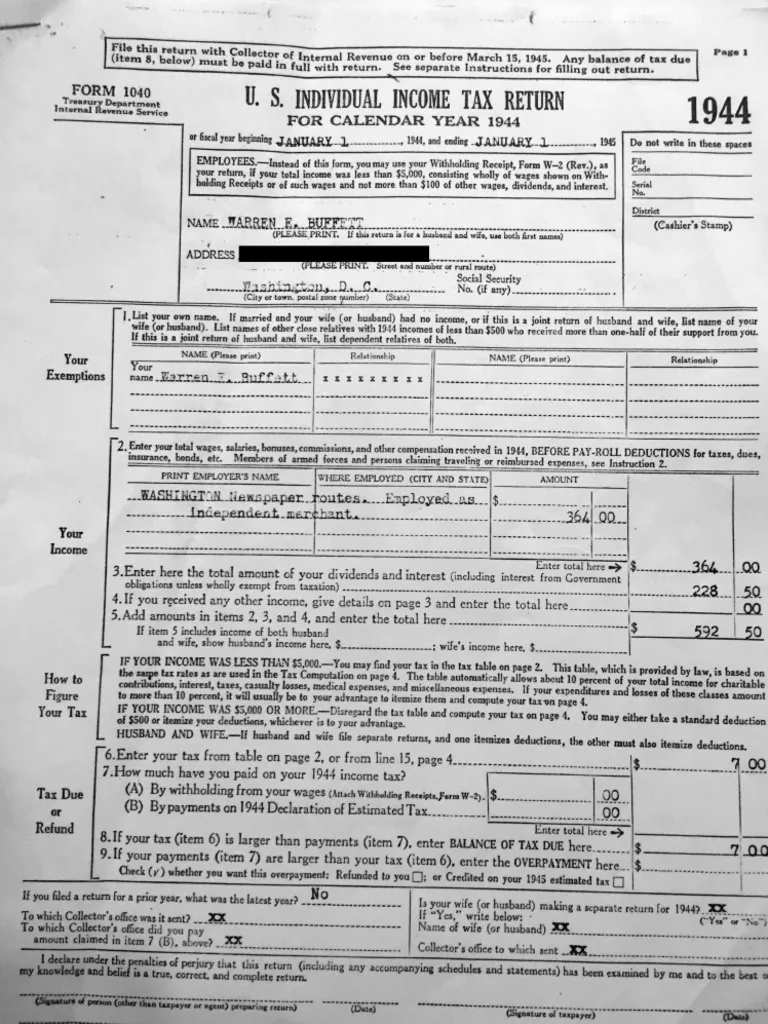
What does Warren Buffett’s first tax return reveal about the legendary investor’s early financial journey? Filed on April 14, 1944, at the age of just 14, Buffett’s tax return shows he owed a mere $7 in federal taxes, a sum that would be equivalent to approximately $132.84 today.
In 1944, Buffett earned a total of $592.50 from his paper route and investments, breaking down to $364 from delivering newspapers and $228.50 from interest and dividends. Under IRS rules at the time, any U.S. citizen earning $500 or more was required to file a federal tax return, which Buffett did, despite his young age.
Buffett’s tax return included deductions of $10 for watch repair and $35 for bicycle costs, showcasing his early understanding of financial management. Reflecting on that time, Buffett stated, “I have paid federal income tax every year since 1944. Though, being a slow starter, I owed only $7 in tax that year.” This statement underscores his long-standing commitment to fulfilling tax obligations.
Buffett’s father, Howard Buffett, was a stockbroker and U.S. Congressman, which likely influenced his early interest in finance and investing. By the age of 11, Buffett had already begun investing, laying the groundwork for his future success.
Fast forward to 2024, and Buffett’s company, Berkshire Hathaway, made headlines by paying $26.8 billion in taxes, the highest-ever payment made to the U.S. government by a single company. This stark contrast to his first tax return illustrates the monumental growth of both Buffett and his business over the decades.
Buffett’s 1944 income, when adjusted for inflation, would equate to approximately $11,244.32 in modern currency, highlighting the significant changes in economic conditions and the value of money over time. His early experiences with taxes and investments have undoubtedly shaped his approach to wealth and philanthropy.
As Buffett continues to influence the financial world, the story of his first tax return serves as a reminder of his humble beginnings and the principles that have guided him throughout his career. While he has become one of the wealthiest individuals globally, his early tax obligations reflect a commitment to responsibility that remains relevant today.
