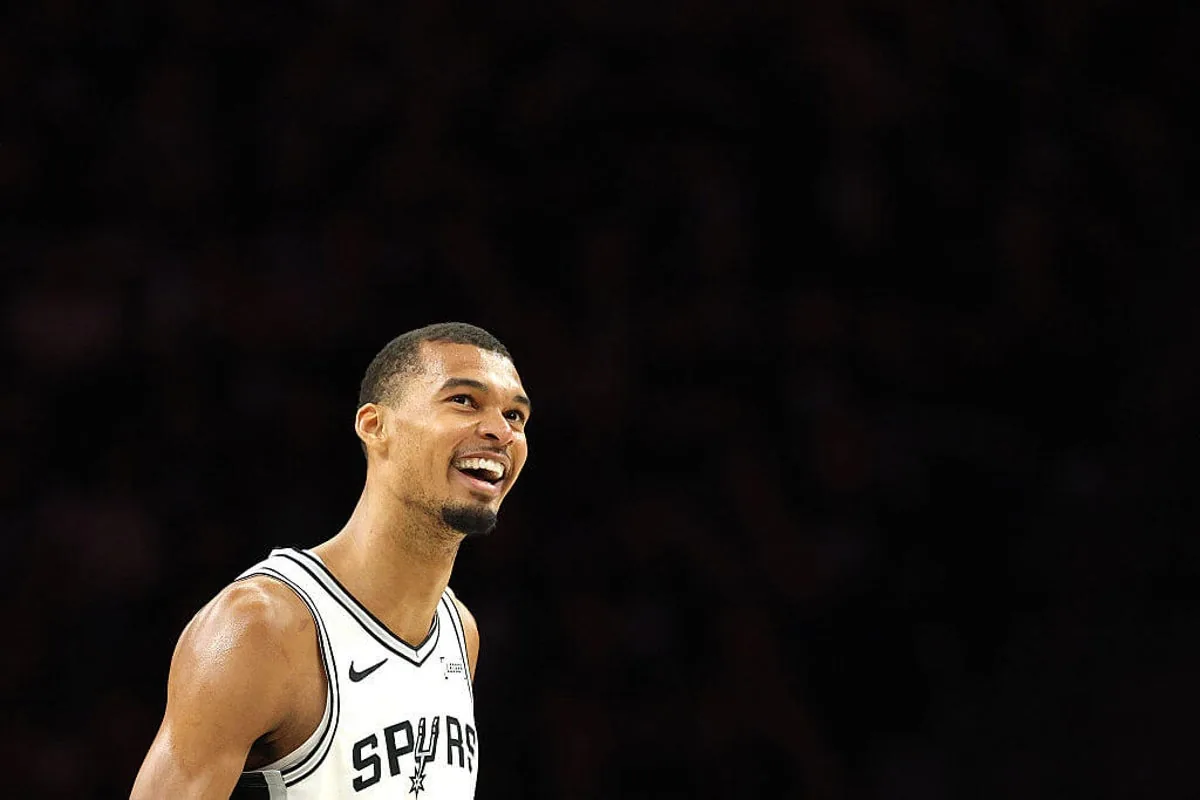
The San Antonio Spurs and Victor Wembanyama have reached an agreement on a five-year rookie contract extension, as announced by the team on Friday. This deal is projected to be worth $252 million, according to a team source. The extension is set to commence in the 2027-28 season, following the conclusion of Wembanyama’s current rookie contract. The initial value of the new agreement will be 25 percent of the NBA salary cap.
Wembanyama, who is 22, guided the Spurs to the NBA Finals in his first playoff appearance. Throughout the season, he developed into one of the league’s top players. He recorded averages of 25 points, 11.5 rebounds, 3.1 blocks, and 3.1 assists across 64 regular-season games. He also secured First-Team All-NBA honors and finished third in MVP voting.
Despite their strong performance, the season concluded with disappointment for the Spurs, as they experienced multiple fourth-quarter collapses in the finals. The New York Knicks ultimately won the series in five games. Wembanyama reflected on the experience, stating that the team gained significant knowledge and experience from the playoff run and season.
Following a season where the Spurs began as playoff hopefuls and evolved into title contenders, they are expected to be among the favorites for the upcoming season. Wembanyama is anticipated to maintain an MVP-level performance, and his new contract reflects this expectation.
Financial implications for the Spurs
Wembanyama’s decision to forgo a “supermax” extension could potentially save the Spurs approximately $50 million over the duration of his extension. This saving is contingent on the cap number for the next season. This translates to roughly $10 million in cap space each season if Wembanyama achieves All-NBA team selection or repeats as Defensive Player of the Year in 2026-27.
This potential $10 million saving is particularly relevant for the 2029-30 season. During this period, core players like Stephon Castle and Dylan Harper will likely see their rookie deals upgraded to max or near-max contracts. Additionally, Devin Vassell, Carter Bryant, and Julian Champagnie will require new deals as their current value contracts expire. De’Aaron Fox will also still be under contract for $62 million.
This move is comparable to Jalen Brunson’s decision in New York to accept less than his maximum contract. Brunson’s choice provided the Knicks with the financial flexibility to make roster adjustments while avoiding the restrictions of the second apron. By keeping Wembanyama at 25 percent of the max, the Spurs could utilize their nontaxpayer midlevel exception in the 2027 offseason and remain below the first apron. This would have been challenging without trading a rotation player.
The Spurs have made another significant extension in the past year, with De’Aaron Fox’s max deal set to begin next season. The team also anticipates future max extensions for Stephon Castle and Dylan Harper, which suggests their cap sheet will become top-heavy in the coming years. On June 29, the Spurs finalized a three-year, $45 million agreement with Julian Champagnie, securing a significant portion of the long-term rotation around Wembanyama.
Contract considerations and team flexibility
Following their loss to Jalen Brunson and the New York Knicks in the NBA Finals, Wembanyama is considering a similar approach to his contract to help the Spurs maintain cap flexibility. Reports indicate that Wembanyama is contemplating signing for less than the potential $251 million maximum he could receive on a new deal.
An extension for Wembanyama could reach up to $301 million over five years if he meets specific designated player incentives, such as winning MVP or being named to an All-NBA team. Given his consistent performance, including leading the NBA in blocks per game in his first three seasons and finishing third in MVP voting, it is plausible he could fully maximize his deal if he chose to.
The current NBA landscape, particularly in the apron era, shows teams are more cautious with spending. James Dolan, the governor of the Knicks, emphasized that he would not spend into the second apron, even after his team’s NBA Finals victory. The Boston Celtics, for instance, have restructured their championship core over the last two offseasons, partly due to the second apron, trading players like Kristaps Porziņģis, Jrue Holiday, and Jaylen Brown.
The Knicks stand out as an exception, largely because Brunson signed a four-year, $156.5 million deal in the summer of 2024. He was eligible for a five-year, $269 million contract if he had waited until 2025. Brunson’s discount allowed the Knicks to acquire OG Anunoby and Mikal Bridges, making him the third-highest-paid player on the team next season, behind Anunoby and Karl-Anthony Towns.
While the exact discount Wembanyama might offer the Spurs is not clear, the team’s roster is approaching a point where it will become very expensive. De’Aaron Fox‘s four-year, $221 million extension begins with the upcoming season, with his 2026-27 salary at $49.5 million, increasing to $53.4 million in 2027-28, which marks the first year of Wembanyama’s extension.
Stephon Castle will become eligible for an extension next summer, followed by Dylan Harper in the summer of 2028. Although the Spurs have some time to manage these contracts, the timeline is not as extensive as they might prefer, especially given their substantial investment in Fox last offseason. The Spurs won 62 regular-season games, making the playoffs for the first time since 2019 and reaching the NBA Finals for the first time since 2014.
Read Also
Source: nytimes.com
